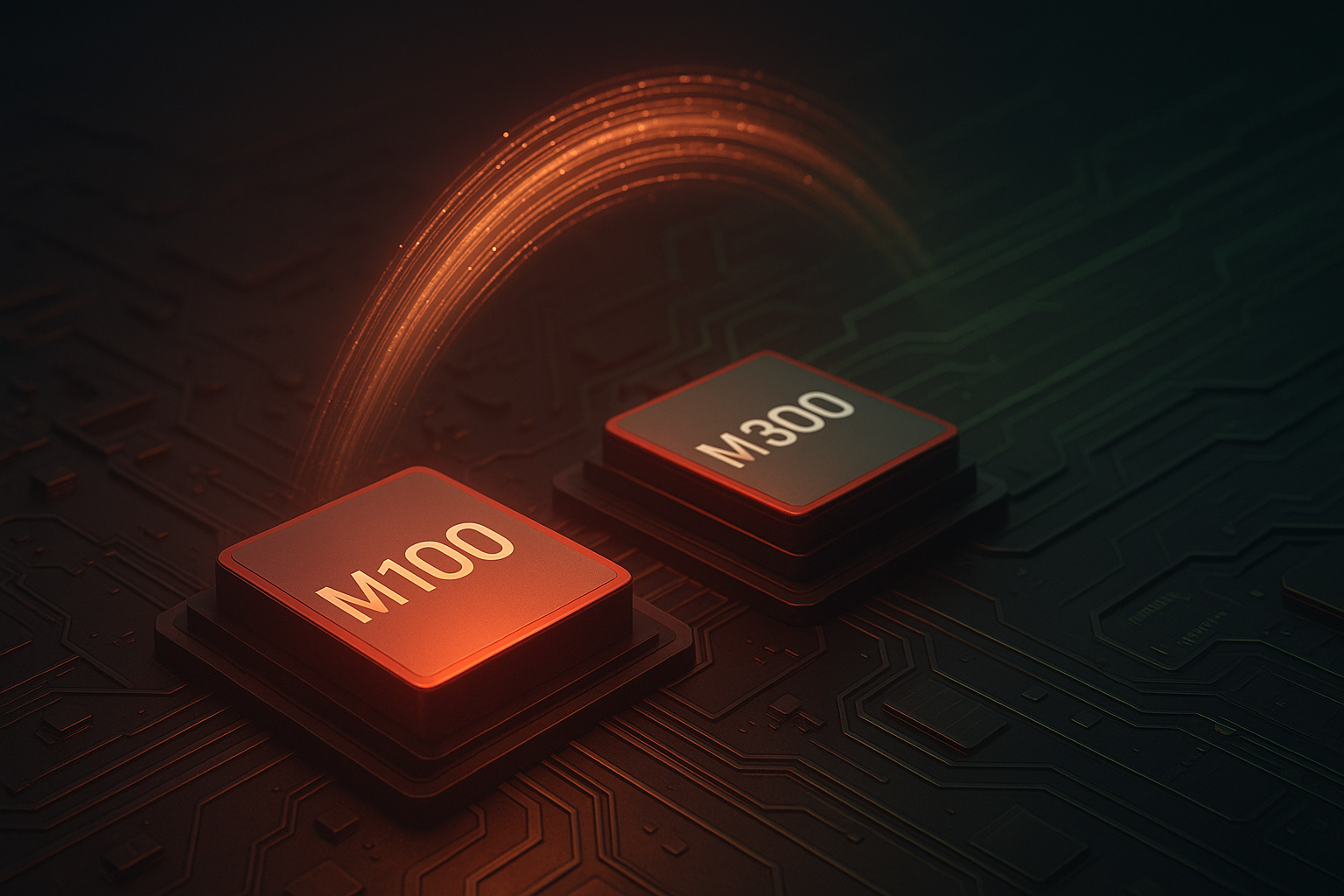
Baidu just made its boldest move yet in the race to dethrone Nvidia.
The Chinese tech giant unveiled two new AI processors: the M100 and M300, designed to power China’s most demanding AI workloads without relying on US technology.
The M100, launching in early 2026, is built for AI inference tasks in advanced language models.
The M300, arriving in 2027, targets large-scale model training. Both chips signal something bigger than product launches: they’re artifacts of Beijing’s coordinated push toward technological sovereignty in artificial intelligence.
The announcement reveals how export restrictions and geopolitical tension are reshaping the global AI infrastructure race, forcing Chinese companies to accelerate domestic alternatives that are narrowing the performance gap with Nvidia faster than many expected.
Building an ecosystem, not just chips
The real strategy becomes clear when you look beyond individual processors.
Baidu isn’t competing on specs alone as it’s building an entire computing ecosystem designed to function without Nvidia’s dominance.
The company plans to cluster its M100 and M300 chips into what it calls Tianchi systems.
Tianchi256, launching in the first half of 2026, will link 256 chips together and deliver a 50% performance boost compared to earlier clusters. Tianchi512, arriving later in the year, will expand that to 512 chips.
This clustering approach mirrors what Huawei is doing with its Ascend chips, overcoming individual chip limitations by pooling massive computing power at the system level.
Critically, Baidu’s Kunlun chips come with CUDA compatibility. That’s a crucial detail. CUDA is Nvidia’s proprietary software framework that virtually every AI developer knows.
By building compatibility, Baidu lowers the migration barrier for teams accustomed to Nvidia’s ecosystem. Developers don’t need to completely rewrite their code or learn entirely new tools.
They can port existing applications with minimal friction. This software-first thinking explains why Baidu’s strategy differs from pure hardware competition; it’s designed to make switching away from Nvidia feel less risky for customers.
Supply chain resilience meets cost advantage
Underneath the technical features sits a harsh geopolitical reality: the US is tightening export controls on advanced semiconductors to China.
Nvidia’s premium H100 and Blackwell chips are largely off-limits. Even the H20, supposedly the China-approved version, has become politically contentious.
Beijing responded in September by quietly instructing major tech firms: Alibaba, ByteDance, and Tencent to pause Nvidia purchases while conducting a “national security review.”
The message was unmistakable: domestic chips are no longer optional.
Baidu’s timing capitalized on this pressure. The company has already deployed 30,000 of its third-generation P800 Kunlun chips in production clusters, proving the concept works at scale.
Alibaba’s internal chips now reportedly match Nvidia’s H20 in performance for many workloads.
Meanwhile, Baidu has won over a billion yuan in chip orders from China Mobile for AI infrastructure projects.
These aren’t hypothetical sales as they are evidence that domestic silicon is moving from laboratory curiosity to operational necessity.
The cost angle matters too. Chinese chips are significantly cheaper to produce locally, with fewer export restrictions to navigate.
As Beijing’s “self-sufficiency” campaign pressures companies to buy domestic, the cost advantages compound with regulatory incentives. For cloud providers and enterprises, that’s compelling economics.
The unfinished picture
China still faces real headwinds. Baidu’s chips excel at inference and training for moderately-sized models but lag Nvidia on cutting-edge research applications requiring maximum raw power.
Energy efficiency remains a question mark; some Chinese clusters reportedly consume 2.5 times more power than comparable Nvidia systems. Software maturity and developer confidence in alternatives to CUDA are still developing.
Production capacity, while expanding, hasn’t yet matched demand.
What Baidu’s chip unveiling reveals, though, is that the bottleneck isn’t technical anymore; it’s geopolitical and economic. Export controls forced innovation.
Now, Chinese alternatives are competitive enough that Nvidia’s dominance in China is fragmenting faster than anyone predicted just two years ago.
The post What Baidu’s new chips reveal about China’s plan to counter Nvidia in AI race appeared first on Invezz